
Your bathroom mirror is not useless — you are just using it wrongly
Most people check their gums by looking at the front of them. That is the least informative view in the mouth. Gum disease starts in the places you cannot see from the front: between the teeth, and behind the last molars.
There is also a habit of dismissing the one signal that matters. Blood on the brush gets explained away — hard bristles, a new toothpaste, tiredness, hormones — and the explanation is usually wrong. Healthy gum does not bleed when it is cleaned properly, in the same way healthy skin does not bleed when you wash it. Bleeding means inflammation, and inflammation is the stage at which everything is still easy to fix.
The other trap is waiting for discomfort. Periodontitis (Parodontitis) is a slow, largely painless process, which is exactly why it gets found late; the mechanism behind that silence is worth understanding on its own, and we cover it in Can you have periodontitis without pain? (EN). For now, take pain off your list of early warning signs entirely.
The self-check: six things, five minutes
Do this in good light, ideally in the evening, and do not rush it.
1. The interdental test — the one that counts. Take floss or a suitably sized interdental brush (Interdentalbürste) and clean between every pair of teeth, including behind the last molars. Watch for blood. Note where it appears, not just whether. One or two bleeding points usually means a spot you have been missing. Bleeding in many places, or on both sides of the mouth, points to generalised inflammation.
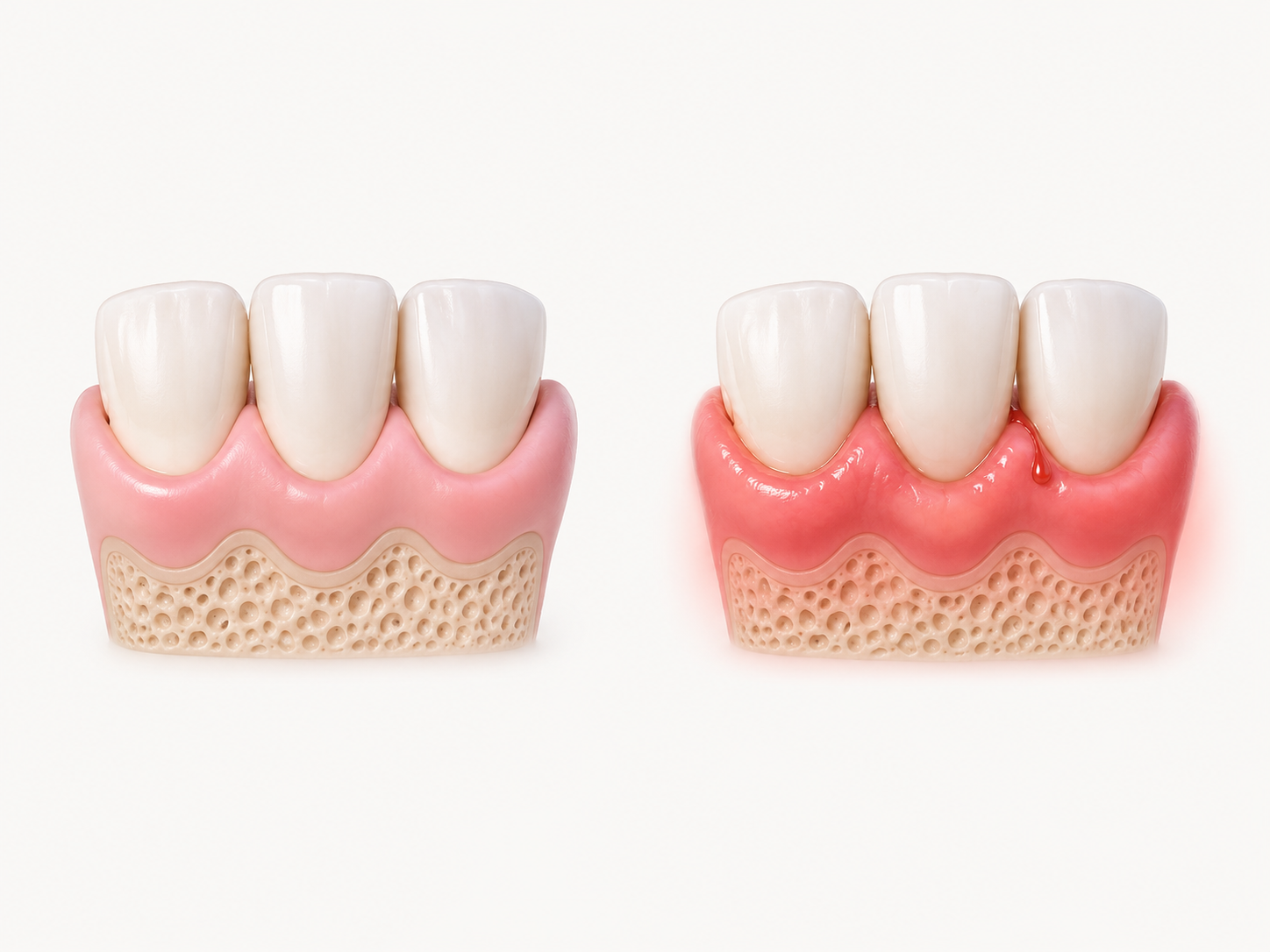
2. Look at the colour and the edge. Healthy gum is pale pink, and where it meets the tooth it tapers to a thin, knife-like edge, with a small pointed triangle filling the gap between neighbouring teeth. Inflamed gum is darker red or bluish, rounded and puffy at the margin, and shiny rather than stippled. Compare left with right — asymmetry is informative.
3. Check the level. Are the necks of some teeth exposed? Does a tooth look longer than its neighbour? Can you see the dark edge of an old crown that used to be hidden? Receding gum means attachment has already been lost, and recession is the sign people most often notice years after it began.
4. Do the smell test. After flossing one contact point, smell the floss. This is undignified and highly informative. A distinct odour from one particular gap, when the rest are neutral, usually indicates a pocket harbouring bacteria at that specific site.
5. Press and wobble. With a clean fingertip, push gently on each front tooth and each molar in turn. Teeth have a trace of natural give; what you are looking for is a tooth that moves visibly more than its neighbours. Also note whether food now packs into a gap that never used to trap anything, and whether your bite feels different.
6. Photograph it. A close-up photo of your upper and lower front teeth, taken today and repeated in three months, shows changes your memory will not. This is the trick that convinces sceptics.
Reading your result
| What you found | What it usually means | What to do |
|---|---|---|
| No bleeding anywhere, gums pale and thin-edged | Gums healthy at present | Carry on; keep your routine check-ups |
| Bleeding at one or two specific points | A site being missed when cleaning | Clean it properly for two weeks, then re-check |
| Bleeding in many places, gums red and puffy | Gingivitis (Zahnfleischentzündung) — reversible | Book an appointment; this is the easy stage |
| Recession, longer-looking teeth, exposed necks | Attachment already lost | Book; ask specifically for pocket measurement |
| A loose tooth, teeth shifting, food packing | Advanced disease likely | Book promptly, do not wait for a check-up |
| Pus, local swelling, one-sided pain | Acute infection | Contact a practice the same day |
The line that matters medically runs between rows three and four. Gingivitis is inflammation of the gum alone, and it resolves completely when the cause is removed. Periodontitis means the inflammation has reached the supporting structures and destroyed some of them, and that part does not simply reverse. You cannot tell which of the two you have by looking. That is the point at which the self-check hands over.
What the dentist sees that you cannot
Pocket depths. A thin probe marked in millimetres is walked around each tooth and the depth of the gap between gum and tooth is read off, several points per tooth. Shallow readings — up to about three millimetres — are compatible with health. Deeper readings mean the attachment has come away from the root and bacteria are living somewhere no brush reaches. This measurement is the backbone of every periodontal diagnosis, and no amount of looking replaces it.
Bleeding on probing. Not whether your gums bleed when you brush, but whether they bleed when the tissue at the bottom of the pocket is touched. It is the most honest available marker of currently active inflammation.
The screening index. German practices use a screening code, the Parodontaler Screening-Index (PSI), which divides the mouth into sextants and records a code from 0 to 4 for each. It is a fast triage tool at a routine check-up: low codes mean no further action, higher codes trigger a full periodontal examination. If you have ever heard numbers being called out during an otherwise unremarkable check-up, that was probably it.
The bone level. X-rays show how much bone still surrounds each root — information that no probe and no mirror can supply. Pattern matters here: even horizontal loss across the whole jaw behaves differently from a deep crater beside a single root.
Mobility, furcations and the awkward corners. Loose teeth are graded rather than guessed, and the spaces between the roots of molars are checked separately, because they are the sites where disease hides best and instruments reach worst.
Sometimes, a bacterial test. Identifying which species are present is possible and is used in specific situations rather than routinely — for instance where the disease is unusually aggressive or has not responded as expected. It is a supplement to measurement, never a substitute.
Where the German system helps you — if you use it
Statutory health insurance covers regular dental check-ups, and for adults one check-up per calendar year is what earns the stamp in your bonus booklet (Bonusheft) — a small document with a large financial effect years later, explained in The Bonusheft: why it pays to start today (EN). A check-up is also where the screening index gets recorded, which means the single most effective early-detection tool available to you costs you nothing and takes a few minutes.
What a check-up is not is a cleaning. Professional cleaning (professionelle Zahnreinigung, PZR) is usually a private service, and the amount your fund contributes to it varies from fund to fund — ask yours directly, since some reimburse a share.
If periodontal treatment does turn out to be needed, it runs on its own approved pathway: findings are recorded, a plan goes to your fund, treatment begins once the plan is approved, and the active phase is followed by staged aftercare over a period of years. The full mechanics are in Does German health insurance pay for periodontitis treatment? (EN). Newcomers often assume a dental problem in Germany means an immediate bill and a fight; for gum disease, that is not how it works.
Who should check earlier and more often
- Smokers. Tobacco suppresses bleeding, which removes your main home signal — so the self-check above is far less reliable for you. See Smoking and gum disease: why tobacco hides the warning signs (EN).
- People with diabetes. Gum inflammation and blood sugar control push each other in both directions.
- Anyone with a family history. Early tooth loss in a parent is worth mentioning at your appointment.
- In pregnancy. Hormonal changes make gums react more strongly, and bleeding is common — see Bleeding gums in pregnancy (EN).
- People under sustained stress, or who grind their teeth. Neither causes periodontitis on its own; both make an existing problem harder to control.
- Anyone with a dry mouth, whether from medication or mouth breathing. Saliva is protective, and less of it changes the environment in the pocket.
If you have just moved to Germany, book a check-up sooner than you think you need one, and bring any records you have. A great many people arrive here having last been examined in a system that worked differently, and the first German check-up is where a quiet, long-running gum problem tends to surface. Doing that appointment in a language you are comfortable in makes a real difference to how much you take away from it — see English-Speaking Dentist in NRW.
No, although it is extremely common. Bleeding on flossing means the tissue in that gap is inflamed. If it is one or two spots and you clean them thoroughly, bleeding usually stops within one to two weeks. If it is still there after that, or if it is widespread, have it looked at rather than accepting it as your normal.
Yes. Brushing cleans the surfaces, not the spaces, and periodontitis begins in the spaces. Risk factors such as smoking, diabetes, a genetic predisposition and certain medications also shift the balance regardless of technique. People who clean meticulously and still develop pockets are a recognised group, not a contradiction.
Bleeding when cleaning between the teeth, usually accompanied by nothing else. Redness and puffiness at the gum margin come next, then bad taste or odour from a particular spot, then recession and loosening much later. By the time a tooth moves, the process has been running for years.
Saliva-based tests exist and can identify bacterial species, but they cannot tell you how much attachment or bone you have lost, which is the question that determines treatment. A test result without pocket measurements is not a diagnosis. Spend the appointment instead.
The screening index belongs to routine check-ups, so keeping those regular covers most people. If you have been diagnosed with periodontitis, measurement is part of every aftercare appointment, at intervals set by how severe your case was — usually more frequent than an ordinary check-up.
Early gum disease does not hurt, does not look dramatic and does not announce itself — but it does bleed, and it bleeds where you clean between the teeth. That single signal, taken seriously rather than explained away, is what separates a problem solved with better technique from one solved with a course of treatment years later. Do the six-point check tonight. If anything on it points beyond a missed spot, have your gums measured, because the difference between gingivitis and periodontitis is a number, and numbers need an instrument.
Zahnarztpraxis Tsypin · Wuppertal. This article was medically reviewed and is provided for information; it does not replace an examination. Updated August 2026.


